
Pakistan's government is exploring measures, including potential smart lockdowns and austerity, to reduce petroleum consumption. This comes after recent fuel price hikes driven by rising global oil prices and West Asia tensions, which have also raised concerns about oil supply disruptions. The government is also implementing a fuel relief scheme and faces public pressure over the price increases.

India is making a significant push to establish itself as a global semiconductor manufacturing hub, driven by strategic investments and policy support. The upcoming SEMICON India 2026 event will showcase the country's advancements and ambitions in this critical industry, which underpins virtually all modern electronic devices and has faced global supply chain vulnerabilities.

Nebex, founded by former Axiom Space executives, aims to build commercial infrastructure for the global space economy.

Prime Minister Narendra Modi celebrated India's 7.8 per cent GDP growth in the April-June quarter, attributing it to the collective strength of the people despite global uncertainties. He criticised "doomsayers" as the economy showed resilience, exceeding expectations even amidst international conflicts and supply chain issues.

Prime Minister Narendra Modi lauded India's 7.8 per cent GDP growth, achieved despite global conflicts and instability. He emphasised the importance of Swadeshi and self-reliance for a developed India by its 100th year of Independence, urging citizens to avoid unnecessary foreign expenditures.

The successful hosting of the 18th BRICS summit in New Delhi has provided a significant boost to the BJP, offering a timely opportunity to strengthen its narrative against the opposition ahead of crucial assembly elections next year. BJP sources highlight the BRICS grouping's strong condemnation of the Pahalgam terror attack and the consensus declaration as major diplomatic victories for the Modi government, countering criticisms of its foreign policy. The party plans to leverage these outcomes during its month-long Seva Sankalp campaign to connect with various sections of society.
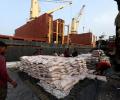
India's exports saw a significant increase of 26.12 per cent to USD 43.81 billion in August, leading to a narrowed trade deficit of USD 26.86 billion, driven by strong demand from key global markets and diverse sectors.
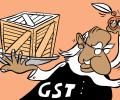
Tax experts clarify that merchants will pay 18% GST on Merchant Discount Rate (MDR) for UPI payments exceeding Rs 2,000, effective October 15. However, registered merchants can claim Input Tax Credit (ITC), mitigating the tax burden. This move is expected to generate significant GST revenue for the exchequer while funding payment infrastructure.

US President Donald Trump has threatened the European Union with "very heavy tariffs" if he perceives their actions as hostile, specifically in response to Canada's efforts to deepen economic and strategic ties with the EU. This comes as European Commission President Ursula von der Leyen invited Canada to become the EU's first "associate member" to strengthen resilience amid global trade uncertainties and US trade policies.

Prime Minister Narendra Modi cautioned against the 'weaponisation' of technology and critical minerals at the BRICS summit, advocating for cooperation to foster shared prosperity. Concurrently, Chinese President Xi Jinping announced plans for an open-source AI ecosystem for BRICS nations, positioning Beijing as a key technology partner amid global AI competition.

'It's A Cat And Mouse Game.'

The United Nations has revised downward India's economic growth forecast for 2026 to 6.4 per cent from an earlier 6.6 per cent, attributing the change to global uncertainties and economic shocks stemming from the ongoing West Asia crisis.

New Delhi was told it had given something up; in reality it had stopped talking about it, notes Dr Abhishek Puri.

PhonePe, at the Global Fintech Fest 2026, unveiled its strategic vision for the next decade, focusing on inclusive digital progress for individuals, households, and businesses across India. The roadmap details innovations in financial inclusion, wealth creation, credit access, and merchant solutions.

It is important to understand that the rupee's appreciation, driven by the 2013 special swap scheme, reduced India's import costs for petroleum, oil, and gold, points out Dr Ashwani Mahajan, National Co-Convenor, Swadeshi Jagaran Manch.

The question for the next 20 years is not whether India can become a $5 trillion or $10 trillion economy. Those are attractive targets, but the real question is whether India can create enough productive jobs, educate its children properly, make its cities liveable, and give hundreds of millions of people a substantially better life, asserts Ramesh Menon.

Mahindra Group Chairman Anand Mahindra announced the company would adopt an 'attack mode' strategy, accelerating investment, innovation, and execution to capitalise on opportunities arising from prolonged geopolitical and economic uncertainty.

Tata Chemicals has stated its commitment to resolving outstanding issues with the Kenyan government after President William Ruto reportedly ordered its subsidiary, Tata Chemicals Magadi Ltd, to cease operations, citing a lack of benefit to citizens.

BRICS nations have successfully reached a consensus on a joint statement following extensive negotiations, with India playing a crucial role in bridging differences, particularly among West Asian members like Iran, Saudi Arabia, and the UAE, despite regional conflicts and geopolitical tensions.

Arundhati Bhattacharyya, Salesforce President and CEO for South Asia, highlighted how cloud and AI are democratising capabilities, offering India a unique opportunity to leapfrog in the technology revolution. Speaking at the IMC Chamber of Commerce, she emphasised that AI will create more jobs by addressing unmet business demands and could significantly boost India's GDP, with NITI Aayog estimating a USD 500-600 billion addition by 2035. She urged Indian businesses to transform using technology, focus on data, redesign work, and invest in skills, stressing that AI is not just for large corporations.
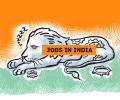
Sridhar Vembu, Zoho Corporation Founder, states that the IT industry is not generating new jobs due to funds being redirected towards the escalating costs of AI and data centre infrastructure. He highlights a structural economic challenge where advanced technology, while making goods affordable, creates income distribution issues and suggests that solutions like Universal Basic Income might gain traction, especially in countries like India.

J R D Tata, chairman of the Tata group from 1938 to 1991, said that whenever he had to make a difficult decision, he would ask himself, what will be good for India, and what will be good for the Tatas. If he had a doubt, he would decide in favour of India. In the long run, it would turn out well for the Tatas too, he said, points out Arun Maira.

The FCNR (B) stratagem relies on using public money to defend the rupee. The State subsidises foreign borrowing to attract dollars. This tool requires large-scale borrowing to make a material difference against a gross external flow of $11 billion a day. A commensurately large fiscal cost falls upon the exchequer. The ministry of finance will choose how much it is willing to spend in exchange for this round number, points out Ajay Shah.

Merchants will be subject to an 18 per cent Goods and Services Tax (GST) on the Merchant Discount Rate (MDR) for UPI payments exceeding Rs 2,000, but can mitigate this burden by claiming input tax credit (ITC), according to tax experts.

Chinese President Xi Jinping is in New Delhi for the 18th BRICS Summit, where he is scheduled to hold bilateral talks with Prime Minister Narendra Modi. This visit, his first to India in nearly seven years, comes amidst efforts to normalise India-China relations following the 2020 Eastern Ladakh standoff and is expected to have significant implications for bilateral ties and BRICS cooperation.

Accel's early investment in RentoMojo, a furniture and appliance rental platform, has paid off handsomely with the company's strong debut on the stock exchanges, listing nearly 19 per cent above its issue price after a significantly oversubscribed IPO.

'Improved law and order and transparent governance have helped change UP's investment image.'
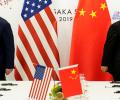
Top US and Chinese officials, including Vice Premier He Lifeng and Treasury Secretary Scott Bessent, held "candid, in-depth and constructive" talks in New York on economic and trade issues, with a specific focus on artificial intelligence. These discussions precede Chinese President Xi Jinping's anticipated visit to Washington and occur amidst new US sanctions targeting countries purchasing Russian oil and gas, and the US unveiling an "AI Force."

Bangladesh is considering joining a newly formed defence alliance between Saudi Arabia, Pakistan, and Turkiye, with junior ministers stating that any decision would be based on national interests and a "Bangladesh First" policy. The pact, signed in Makkah, aims for collective deterrence.

Infosys Chairman Nandan Nilekani stressed the need for India to develop population-scale tokenisation infrastructure capable of handling billions of transactions, rather than merely focusing on issuing tokens. He highlighted the importance of interoperability, liquidity, and high volumes for tokenisation to expand across various asset classes and use cases.

Former CDS Anil Chauhan stated that China poses a long-term and comprehensive challenge to India, with the boundary issue remaining unresolved due to differing perceptions of the Line of Actual Control. However, he emphasised that India's ties with Beijing cannot be solely defined by border disputes, advocating for engagement through platforms like SCO and BRICS. He also highlighted the broader global geopolitical flux and instability in India's neighbourhood as significant security concerns, stressing the need for self-reliance.

A coalition of 25 Democratic-ruled US states has filed a lawsuit against the Trump administration's decision to impose new tariffs on 60 economies, including India. The states contend that these tariffs, ostensibly aimed at combating forced labour, are illegal taxes that will raise costs for consumers and businesses, and were implemented without proper legal justification.

The United States and the European Union have strongly criticised India's trade policies at the World Trade Organization review, highlighting concerns over high tariffs, quality-control orders (QCOs), and restrictions on digital trade and services, which they argue undermine India's economic openness.

'They are claiming that they are very good in governance. All governments do propaganda. This is the propaganda of the government that they are doing very well, in spite of all the troubles.'
'They are claiming that they are very good in governance. All governments do propaganda. This is the propaganda of the government that they are doing very well, in spite of all the troubles.'

Arundhati Bhattacharya, Salesforce President and CEO for South Asia, stated that cloud and AI are democratising capabilities, offering India a unique opportunity to leapfrog in technology. Speaking at the IMC Chamber of Commerce, she emphasised that AI will create more jobs and urged Indian businesses to transform using technology, rather than merely digitising. She also highlighted the significant economic potential of AI adoption for India.

The BJP has announced a month-long 'Seva Sankalp Abhiyan' campaign, starting on Prime Minister Narendra Modi's birthday, September 17, to commemorate his 25 years in public life. The initiative includes various programmes like 'Seva Diwas', 'Ashirwad Ka Diya', 'Seva Jyoti Kalash Yatra', youth yatras, and innovation challenges, all aimed at public participation and promoting the vision of 'Viksit Bharat 2047'.

The US House of Representatives is debating a bill that would authorise the President to impose sanctions on Russia and steep tariffs on its oil and gas trading partners, including India and China. The bill, aimed at pressuring Russia over the Ukraine war, has faced opposition but is expected to be put to a vote.

Prime Minister Narendra Modi has introduced a 'Sapta Dhara' (seven-stream) reform framework, aiming to propel India into a developed nation by 2047. This comprehensive plan focuses on key sectors including manufacturing, agro-food processing, technology, logistics, defence, green and blue economy, and soft power, leveraging the nation's youth potential.
Prominent individuals, including Infosys co-founder Nandan Nilekani and Zerodha founders Nithin and Nikhil Kamath, have appeared on a notice list during Karnataka's Special Intensive Revision (SIR) of electoral rolls due to various discrepancies. Authorities clarify that these notices are part of a verification process and officials will assist in resolving the issues without inconveniencing the individuals, also debunking reports about CM D K Shivakumar's mother receiving a notice.
